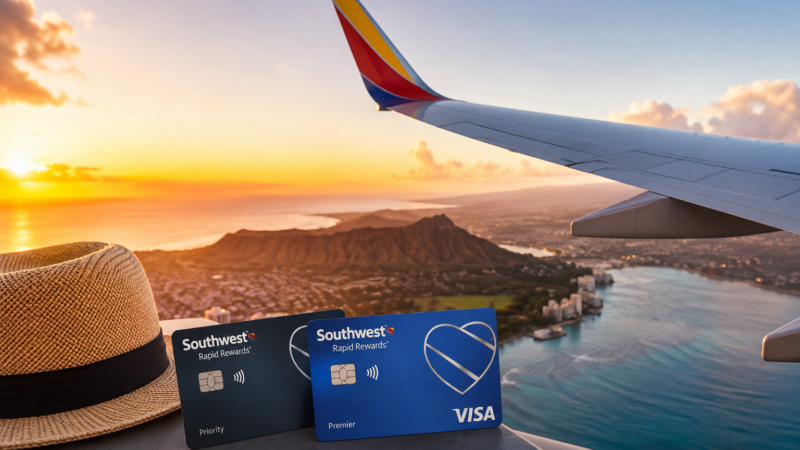
The Southwest Companion Pass is the single best domestic travel benefit in the points and miles world — bring a designated companion on every Southwest flight you take (paid or award), unlimited times, for just the $5.60 in taxes each way. I’ve earned it three times, and the credit card shortcut is still the fastest path. Here’s exactly how to lock in a Companion Pass that’s valid through the end of 2027, and why timing matters more than which cards you pick.
Elevate Miles Verdict
Open one personal Southwest card and one Southwest business card, time the welcome bonuses to post in January 2026, and you’ll walk out with a Companion Pass valid through December 31, 2027 — nearly two full years of buy-one-get-one flights. The Performance Business card ($299 fee, 80,000-point bonus) plus any personal card is the cleanest path. Skip this strategy if you’re already at 5/24 with Chase or can’t hit $6,000+ in combined organic spend.
What follows is the strategy I’ve used personally, updated for the 2026 rule set after Southwest’s massive overhaul this year — the end of open seating, the new Groups 1–8 boarding, and how Companion Pass boarding actually works now. If you’re planning any domestic trip in 2027, from Las Vegas to Orlando, hotel budgets tend to move a lot faster than airfare so it’s worth checking Vegas availability before you commit to your dates.

What the Southwest Companion Pass Actually Gets You
The Companion Pass is straightforward on paper and enormous in practice. It allows you to bring a guest on any Southwest flight for the cost of the taxes and fees, only $5.60 per person on one-way flights within the U.S. Your companion flies with you whether you paid cash or booked with points, and there’s no cap on how many times you can use it during the pass’s lifespan.
Two rules matter here. You can take advantage of the benefit an unlimited number of times (while your Companion Pass is valid) for cash or points flights anywhere that Southwest flies. The Companion Pass benefit only applies to a designated companion, so you can’t bring a random stranger on a whim. However, you can change your designated companion up to three times per calendar year, so you don’t necessarily need to bring the same person along each time you use it. The only real restriction: your companion can’t fly without you.
The math on this is silly. I’ve used the pass for a $600 round-trip to Kauai (companion flew for $11.20 in fees), a last-minute $340 Phoenix run, and half a dozen $180 weekend flights to see family. In a single busy year, a Companion Pass has saved me over $3,000 in second-ticket costs. If your travel partner mostly stays domestic with you, this benefit alone justifies the entire two-card play.
The 2026 Qualification Rules (What Counts and What Doesn’t)
To qualify, simply fly 100 qualifying one-way flights or earn 135,000 qualifying points in a calendar year. You’ll earn a Companion Pass for the following full calendar year, plus the remainder of the year in which you earned it. That “remainder of the year plus the entire following year” clause is the whole game — and why timing your bonuses is more important than card selection.
Here’s the crucial distinction people miss. A Companion Pass qualifying point is any Rapid Rewards point that will count toward earning a Companion Pass. Companion Pass qualifying points are earned from your revenue flights booked through Southwest, your points earned by making purchases with a Southwest Rapid Rewards Credit Card, and your base points earned from Rapid Rewards partners. Purchased points, points transferred between members, points converted from hotel and car loyalty programs, and e-Rewards, e-Miles, Valued Opinions and Diners Club, points earned from Rapid Rewards program enrollment, tier bonuses, flight bonuses, and partner bonuses (excluding bonus points earned on Southwest Rapid Rewards Credit Cards from Chase) do not count toward Companion Pass.
Translation: the giant welcome bonus on a Southwest Chase card counts fully. The 60,000 Chase Ultimate Rewards points you might transfer over from a Sapphire Preferred? Those do not count. This is the trap that catches new points people every year — they think they can transfer their way to a Companion Pass and can’t.
The 10,000-Point Cardholder Boost
This is the quiet superpower of holding any Southwest credit card. Members with an open Southwest Rapid Rewards Credit Card on the first business day of each calendar year will earn one boost of 10,000 Companion Pass qualifying points each calendar year. It is one boost per Rapid Rewards member — not one per card.
So if you carry any Southwest card into 2026, your real target isn’t 135,000 — it’s 125,000. And every dollar of spend on those cards is a qualifying point too. Anniversary bonuses on Southwest cards (3,000 to 9,000 points depending on the product) also count toward the pass, though those don’t hit until 12 billing cycles after account opening, so they rarely help in your qualifying year.
Current Southwest Credit Card Welcome Bonuses (Late 2026)
The big elevated offers we saw earlier this year — Priority at 90,000 points, Premier at 85,000, Plus at 80,000, valid May 28 through July 1, 2026 — expired. Public offers rotate frequently, and Southwest typically pushes elevated bonuses again in the fall and winter. As of now, here’s where the standard bonuses sit:
| Card | Welcome Bonus | Min. Spend | Annual Fee | Anniversary Bonus |
|---|---|---|---|---|
| Southwest Rapid Rewards Plus | 50,000 points | $1,000 / 3 mo | $99 | 3,000 pts |
| Southwest Rapid Rewards Premier | 60,000 points | $2,000 / 3 mo | $149 | 6,000 pts |
| Southwest Rapid Rewards Priority | 60,000 points | $2,000 / 3 mo | $229 | 7,500 pts |
| Premier Business | 60,000 points | $3,000 / 3 mo | $199 | 6,000 pts |
| Performance Business | 80,000 points | $5,000 / 3 mo | $299 | 9,000 pts |
TPG’s current valuations peg Southwest points at roughly 1.25 cents each, so an 80,000-point bonus from the Performance Business card runs around $1,000 in flight value — and every one of those points counts toward the pass. My honest read: if you can hit $5,000 in three months on a business card, the Performance is the highest-leverage single card in this lineup. It gets you 80,000 CPQPs from the bonus, 10,000 from the annual boost, and another 5,000+ from spending — that’s 95,000 of the 135,000 you need from one card alone.
Wait for the Elevated Offers If You Can
The previous standard offers provided 50,000 Rapid Rewards points, so even the lowest of these represents a substantial jump. Southwest has historically pushed elevated welcome offers on the personal cards in the September-through-February window — sometimes hitting 90,000+ points, and occasionally bundling a promotional Companion Pass into the offer itself. I’d watch for those before pulling the trigger, especially if you’re targeting a January 2026 bonus post date. Rate movements on hotel bookings for the same period can be dramatic too, and prices can swing $80–$150 a night depending on when you look, so lock those in early alongside your card plan.
The Two-Card Strategy: The Fastest Path to Companion Pass
The classic move is to pair one personal Southwest card with one business Southwest card. Both welcome bonuses post to the same Rapid Rewards account, and combined they easily clear 135,000 qualifying points once you factor in minimum spend and the 10,000-point boost. Because Chase only allows one personal Southwest card at a time (and enforces a 24-month rule between bonuses on any personal Southwest product), the personal + business combo is the only path if you want two large bonuses in one shot.
You should be able to earn a Companion Pass, or come very close, by earning 2 welcome bonuses (after meeting minimum spending requirements). Since you can’t have 2 personal Southwest co-branded credit cards at once, this needs to be done by opening 1 personal Southwest card and 1 business Southwest card. Same person on both applications — the bonuses need to land in one Rapid Rewards account.
Here’s a sample math on a Priority + Performance Business pairing at current standard offers:
- Southwest Priority welcome bonus: 60,000 CPQPs
- Southwest Performance Business welcome bonus: 80,000 CPQPs
- 10,000-point cardholder boost (once per member): 10,000 CPQPs
- Points from meeting $2,000 + $5,000 in minimum spend: ~7,000+ CPQPs
- Total: ~157,000 CPQPs — well past the 135,000 threshold
If you catch an elevated offer window, you’ll blow past 135,000 with room to spare and still have a huge point stash left in your account after the pass activates.
Do You Actually Qualify for a Business Card?
Yes, probably. This trips up more people than any other part of the strategy. Qualifying for a business credit card may be easier than you think. Your business doesn’t need to be big to qualify for a credit card. Many small businesses, such as selling items on eBay, running a blog, or driving for Uber, can allow you to apply for business credit cards. Sole proprietorships are fine — you don’t need an LLC. On the application, you list yourself as the business owner and use your Social Security number as the tax ID.

The Timing Trick That Doubles Your Companion Pass Lifespan
This is the single most important section in this guide. Get this wrong and your pass lasts one year. Get it right and it lasts almost two.
Points earned through spending using the Rapid Rewards Credit Card will count toward Companion Pass qualification based on when they are posted to your Rapid Rewards account and NOT based on spending date. The points post to your Rapid Rewards account after your statement closing date. Credit card points posted to your Rapid Rewards account in 2026, including bonus points, will count toward qualifying for a 2026 Companion Pass.
Read that twice. The trigger is when the points post, not when you spent the money. That means you can apply for a card in October or November, start spending immediately, and control the timing of your welcome bonus by choosing when to hit the minimum spend threshold.
Here’s the play, straight from the community wisdom that’s worked for years: If you apply for cards in Oct/Nov/Dec — you want the final dollar of each minimum spend to post in January, NOT before December 31st. Here’s why: once you earn the Companion Pass, it lasts the rest of that calendar year plus the entire next calendar year. If your bonus points post in December 2025, your pass covers what’s left of 2025 plus all of 2026 — essentially just one year. But if those points post in January 2026, you get all of 2026 and all of 2027. That’s nearly two full years!
Same principle applies for 2027 timing. If you’re reading this in late 2026 and you want a 2027–2028 Companion Pass, apply for cards in October or November 2026, start spending, and time your minimum spend so the last dollar posts on a statement that closes in January 2027. Your welcome bonus lands in January, your pass is granted a few days later, and it’s valid through December 31, 2028.

Before you book: check the award space
Search millions of award seats across airlines, and get alerts when the flights you want become available.


 +80
+80Free to search · alerts are paid · partner link
Watch Your Statement Cycle Dates
This is where people mess up. If your December statement closes on, say, December 22nd, then a $100 purchase on December 21st will post to your Rapid Rewards account in late December — potentially killing the strategy. Log into Chase, find your statement closing date, and make sure your final “trigger” spend happens after that December statement closes but still within the three-month welcome bonus window.
Chase Application Rules You Need to Know
Chase runs the tightest approval rules of any major issuer, and Southwest cards live under all of them. Three things will get you denied:
The 5/24 rule. Chase applications will be declined if 5 new cards have been added to your personal credit report in the past 24 months. This applies to personal Southwest cards. Business cards from Chase are subject to 5/24 for approval but don’t count toward the total, so they’re safer if you’re already near the limit.
The 24-month personal Southwest rule. You’re not eligible for one of these cards if you are a current cardmember of any personal Southwest Visa Card, or a previous cardmember of any personal Southwest Visa Card who received a new cardmember bonus within the last 24 months. That means the three personal cards are mutually exclusive — pick your favorite and lock in for two years.
The velocity rules. You’ll be declined if you apply for a 5th Chase card (personal or BUSINESS) in 6 months. Space out applications by at least 30 days, ideally 90 days between two Chase business cards, and give yourself the best shot at approvals.
My recommended order: business card first (it doesn’t add to 5/24, which protects your personal card approval odds), then the personal card 30+ days later. Meet both minimum spends by January.
A balance is only worth what you can actually book with it. Search award space on Seats.aero to find out what these points are worth on real dates rather than in theory.
What that balance actually books
Earning the points is the easy part. Whether they turn into a seat depends on flight award space, which no transfer chart or earning guide will tell you. Seats.aero searches every major program at once so you can see what your balance books on real dates.
How the 2026 Southwest Overhaul Changed the Companion Pass
Southwest fundamentally reinvented itself this year. Southwest transitioned from open to assigned seating on January 27, 2026. With most fares, Customers are able to choose their seat at booking (except for Basic fares) and moved from A/B/C boarding groups with numbered positions to a new boarding structure using Groups 1 through 8.
For Companion Pass holders, this changed the boarding calculus. Under the new system: for flights on or after January 27, 2026, boarding group will be assigned for Companion Pass holders and Companions based on their seat location or Credit Cardmember/Tier boarding benefit, whichever is higher. Both of you get the better of the two boarding positions, which is a genuine upgrade over the old “run to the gate and hope for adjacent B seats” chaos.
The catch: Sequential boarding is not guaranteed. Note that a seat will not be assigned automatically. After booking the companion’s ticket, you will need to go back into the reservation and select “modify seat” to select a seat (if eligible). Two-step process now — book the primary ticket, add the companion, then go back in and pick the companion’s seat if your card benefits allow it.
Which Cards Get Which Seat Perks in 2026
For flights departing on or after January 27, 2026, Priority and Performance Cardmembers will be able to select a Preferred or Standard seat at the time of booking, when available, and an Extra Legroom seat within 48 hours of departure, if available, at no additional cost, with associated boarding benefits. Premier Consumer and Business Cardmembers will be able to select a Preferred or Standard seat within 48 hours of departure, if available, at no additional cost, with associated boarding benefits.
If you want your companion to actually sit next to you on a busy flight, the Priority or Performance Business card is the right pick — book-time seat selection is the only way to lock down side-by-side seats before the plane fills up. On heavily booked routes to places like Orlando, having that at-booking seat selection is the difference between traveling together and playing musical chairs, so it’s worth checking Orlando dates before you commit if that’s where you’re headed.
The Full Companion Pass Earning Math (Worked Example)
Let me walk through the exact scenario I’d run today if I were targeting a January 2027 Companion Pass activation.
Step 1 — Late October 2026: Apply for the Southwest Performance Business card. Start spending, but don’t rush the minimum spend. Target $4,000 spend in October–December so you cross $5,000 after your December statement closes.
Step 2 — Late November 2026: Apply for the Southwest Priority personal card (30+ days after the business card). Start spending, target the same “cross the finish line in January” approach — hit ~$1,500 by end of December, save the last $500 for early January.
Step 3 — Early January 2027: Push both cards over the minimum spend after your December statements close. Points post on your January statements.
Step 4 — Late January / Early February 2027:
- Performance Business welcome bonus posts: +80,000 CPQPs
- Priority welcome bonus posts: +60,000 CPQPs
- 10,000-point cardholder boost hits: +10,000 CPQPs
- Spend points from ~$7,000 in purchases: ~10,000+ CPQPs
- Running total: ~160,000 CPQPs
Companion Pass activates within a few days of hitting 135,000. It’s valid immediately and runs through December 31, 2028. You’ve got roughly 23 months of buy-one-get-one flights, plus 160,000+ Rapid Rewards points still sitting in your account to spend on flights.
Card Comparison: Which Personal Southwest Card Is Right?
| Feature | Plus ($99) | Premier ($149) | Priority ($229) |
|---|---|---|---|
| Standard welcome bonus | 50,000 pts | 60,000 pts | 60,000 pts |
| Southwest earn rate | 2x | 3x | 4x |
| Anniversary bonus | 3,000 pts | 6,000 pts | 7,500 pts |
| Seat selection at booking | No | No (48hr window) | Yes, Preferred/Standard |
| Extra Legroom upgrade | No | No | Yes, 48hr before departure |
| Annual travel credit | — | — | $75 Southwest credit |
| Foreign transaction fee | None | None | None |
My honest take: the Priority card is worth the extra $80 over the Premier if you fly Southwest more than three times a year with a companion. The book-time Preferred seat selection alone justifies the fee once you’ve experienced trying to score adjacent seats on a full flight without it. The $75 annual Southwest travel credit knocks the effective fee down to $154, and the 7,500-point anniversary bonus is worth about $95 in flights — so you’re really paying $60 net for a premium travel product.
If your only goal is the Companion Pass and you don’t care about ongoing perks, the Plus card at $99 with the lower $1,000 minimum spend is the cheapest way to grab a welcome bonus. Just downgrade or cancel before the second annual fee hits.
Where the Companion Pass Actually Shines
Southwest’s route map dictates where this pass pays off. It’s outstanding for domestic city pairs and Southwest’s Caribbean/Mexico/Central American network. It’s useless for European or transpacific travel because Southwest doesn’t fly there. My biggest wins on the pass:
- Weekend Vegas runs. Peak cash fares hit $400+ round-trip. Companion Pass turns that into $11.20 in fees for the second ticket. I’ve done this eight or nine times.
- Family holiday travel. The one time of year airfare is impossible to justify. Companion Pass makes Thanksgiving or Christmas travel cost only your ticket.
- Beach getaways. Southwest to Florida beaches, Hawaii, or Cancun. Points bookings still get the companion for free — that’s the compounding value.
- Award redemptions. Book your ticket on points, companion comes free. This is where the pass doubles the value of every Southwest point you own.
For coastal trips to LA especially, cash rates on hotels move faster than airfare in my experience, so it pays to lock in LA hotel rates before booking your Southwest flights and playing the Companion Pass angle.

Common Mistakes That Kill Your Companion Pass Timing
I’ve watched friends blow the Companion Pass strategy in the same three ways year after year:
Rushing the minimum spend in December. The single most common mistake. You apply for cards in November, get excited, hit the minimum spend by December 15, welcome bonus posts December 22 — and now your Companion Pass lasts one year instead of two. Slow down. The three-month welcome bonus window is a maximum, not a target.
Transferring Ultimate Rewards to Southwest and expecting it to count. Chase points transfer 1:1 to Southwest, but points converted from other loyalty programs (including Chase Ultimate Rewards, Bilt and Marriott Bonvoy) do not count toward your qualifying points goal. If your plan is to move 100,000 UR points over and coast, the plan doesn’t work. Those points can pay for the flights, but they won’t qualify you for the pass.
Ignoring 5/24. If you’ve opened 5+ personal cards in the last 24 months, your Chase personal Southwest application is getting auto-denied. Check your credit report before applying and consider going business-card-first to avoid the personal card denial.
Which Card Combo Is Right for You?
- Go Priority + Performance Business if you fly Southwest 5+ times a year and want book-time seat selection for both cardholder benefits and Companion Pass boarding
- Go Plus + Premier Business if you just want the Companion Pass at the lowest possible annual fee outlay ($99 + $199 = $298) and plan to cancel after year one
- Go Performance Business only if you’re at or over 5/24, since business cards don’t count toward the limit and this card gets you 95% of the way to Companion Pass alone
- Skip this entirely if you don’t spend $6,000+ across three months, don’t fly Southwest domestically, or live in a market Southwest doesn’t serve well
How to Stack Value After You Earn It
Getting the pass is step one. Squeezing maximum value out of it is where casual users leave money on the table. A few things I do every time:
Book Southwest with Rapid Rewards points and add your companion — you double the value of every point since your companion flies for taxes only. On a 40,000-point flight, the second ticket you’d otherwise buy at $500 cash effectively cuts the point cost in half.
Watch for Rapid Rewards partner base points that count. Base points earned from purchases with Rapid Rewards partners, such as hotels, car rentals and the Rapid Rewards shopping portal all count toward Companion Pass qualification. If you’re already booking hotels or renting cars, routing them through Southwest’s partner program tops off your CPQPs.
Layer Chase Ultimate Rewards transfers for pure point stockpiling (even though they don’t earn the pass). If you have a Sapphire Preferred or Ink card, moving UR points to Southwest 1:1 gives you more inventory to spend once the pass is active — and every one of those bookings brings your companion along for free.
Time your card cancellations. Both business cards and the personal card have real ongoing perks (annual anniversary points, cardholder boosts, seat selection), but you’re not obligated to keep them past year one. I usually keep the Performance Business and Priority for two full years, then downgrade whichever one I’m using less. For nailing down redemption timing across programs, our current transfer bonus guide is worth bookmarking.
Frequently Asked Questions
Do I have to redeem my points for the Companion Pass?
No. Once you earn the 135,000 qualifying points needed, you’ll automatically earn the Companion Pass. Those points do not need to be “cashed in” for the pass and can still be used as redeemable points towards free flights on Southwest. The pass activates in addition to your point balance, not instead of it.
Can I earn the Companion Pass by transferring Chase Ultimate Rewards points to Southwest?
No, and this is the number one mistake new points travelers make. Points transferred from Chase Ultimate Rewards, Bilt, Marriott Bonvoy, or any other loyalty program do not count as Companion Pass qualifying points. Only points from Southwest revenue flights, Southwest credit card spending (including welcome bonuses), and base points from Rapid Rewards partners count.
Can I change my designated companion during the year?
Yes, up to three times per calendar year. That flexibility means you can rotate between a partner, a parent, and a friend across a single year of the pass. Change your companion in the “My Account” section on Southwest.com, in the app, or by calling Rapid Rewards at 1-800-435-9792.
Does the Companion Pass work on flights to Hawaii and international destinations?
Yes. The Companion Pass is valid on any Southwest flight (even flights to Hawaii and the Caribbean), as long as there is a seat available. Your companion still only pays taxes and fees, which run slightly higher on international routes but are still a fraction of a full second ticket price.
What happens if I earn the Companion Pass in December instead of January?
Your pass is valid for the rest of the calendar year you earned it plus the entire following year. Earn it in December 2026 and your pass runs from December 2026 through December 31, 2027 — roughly 12 months. Earn it in January 2027 and it runs through December 31, 2028 — nearly 24 months. Timing your welcome bonus post date matters more than any other decision in this strategy.
Can I qualify for a business card without owning a “real” business?
Yes, in most cases. Sole proprietorships qualify — that includes freelance work, rideshare driving, reselling on eBay, running a blog, or any ongoing side income. On the application, you list yourself as the business owner and use your Social Security number as the tax ID. You do need to answer honestly about your business type and revenue.
Do the anniversary bonus points count toward Companion Pass qualification?
Yes. The anniversary points on Southwest cards (3,000 to 9,000 depending on the card) count as qualifying points, and they post 12 billing cycles after account opening. That’s why the timing of the anniversary matters — a January card open date means anniversary points post in January, which stacks with the 10,000-point cardholder boost for a fast start to a second Companion Pass qualification year.
Bottom Line
The Southwest Companion Pass is still one of the highest-value plays in domestic travel, even after the 2026 program overhaul killed open seating and added bag fees. If you have the credit to pull off one personal + one business Southwest card, time the welcome bonuses to post in January, and can commit to $6,000–7,000 in combined minimum spend, you’re getting a pass valid through the end of 2027 (or 2028 if you’re reading this in late 2026) plus 150,000+ points to spend along the way.
Skip this if you’re already at 5/24, can’t reliably hit the minimum spends without manufactured spending games, or don’t fly domestically enough to use the pass. For everyone else — especially couples who take even three or four Southwest trips a year — this is the strongest points-and-miles move you’ll make in 2026. Start planning your card applications for late October, watch for elevated bonus offers before you pull the trigger, and get your last dollar of minimum spend posting after your December statement closes. If you’re layering in hotel bookings for those Companion Pass trips, rates for the same properties often swing significantly by booking window, so lock those in the moment you know your dates. For more on stacking transferable currencies alongside this strategy, check our monthly transfer bonus roundup and the full points strategy library at Elevate Miles.