I’ve spent a decade trying to sleep in economy class. I’ve folded myself into bulkhead seats, hoarded extra blankets, and paid a small fortune for exit rows. So when Air New Zealand first teased a product called Skynest — actual bunk beds in the economy cabin of a long-haul flight — I filed it away under “cool concept, never happening.”
Well, I was wrong. As of April 2026, Skynest is very, very real — and it’s officially coming to the skies. Air New Zealand just held a live pop-up experience in New York City at Brookfield Place today (April 14, 2026) where the public got to climb inside the pods for themselves. Bookings open May 18, 2026 for flights starting November 2026.
This is genuinely the most interesting thing to happen to long-haul economy travel in decades — and as a points nerd who’s booked plenty of Auckland flights, I have a lot of thoughts. Let’s break it all down.
What Is the Air New Zealand Skynest?
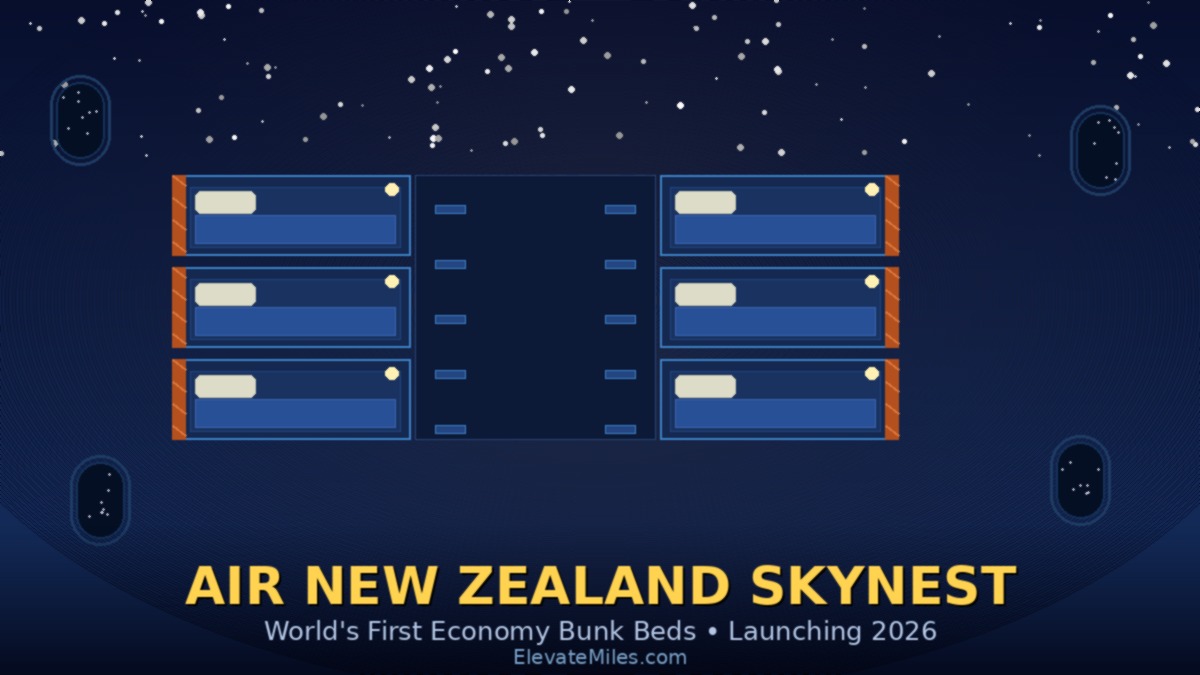
The Skynest is a dedicated sleep pod section located between the premium economy and economy cabins on select Air New Zealand Boeing 787-9 Dreamliners. It features six individual lie-flat bunk beds arranged in a triple-stack configuration — three bunks on each side of the cabin monument, in a “V” shape.
Here’s the key distinction from anything else on the market: this is not a converted seat. This is not a row of economy seats with the armrests up. These are actual bunk beds, purpose-built for sleep, installed in a separate dedicated space. Think crew rest bunks — but for regular passengers. That’s essentially the concept, and it’s a first in commercial aviation.
Skynest Specs at a Glance
| Feature | Details |
|---|---|
| Number of pods | 6 (three stacked vertically, each side) |
| Bed dimensions | 80″ long (2.03m) × 23″ wide (58cm) |
| Session length | 4 hours per session |
| Max sessions per flight | 1 per passenger |
| Location on plane | Between Premium Economy and Economy |
| Aircraft type | Boeing 787-9 Dreamliner |
| Eligible passengers | Economy & Premium Economy (not Business) |
| Bedding changeover | 30-minute turnaround between sessions |
| Price (starting) | $495 USD per session (add-on to base fare) |
What’s Included in a Skynest Session?
For $495, you’re not just getting a flat surface to lie on. Air New Zealand has thought through the experience carefully. Each pod includes:
- Full bedding: full-size pillow, sheets, and a blanket (changed between every passenger)
- Privacy curtain to close off your pod from the aisle
- “Nestcessities” amenity kit: eye mask, socks, ear plugs, dental kit, and skincare from Aotea — a New Zealand natural beauty brand
- USB charging outlet
- Individual reading light
- Personal ventilation nozzle
- Storage pocket for your essentials
- Seatbelt for use during turbulence
- Lighting designed for sleep — warm, dimmed tones tuned to help you drift off faster
The crew will gently brighten the lights at the end of your session — and if you sleep through that cue, they’ll give you a quiet wake-up. You’ll then return to your assigned economy or premium economy seat. You’re limited to one session per flight, so no stacking three consecutive blocks to create a full-flight flatbed experience.
Which Routes Will Have Skynest?
Air New Zealand is being strategic about deployment. Skynest is being installed on newly delivered Boeing 787-9s — not on the existing 14 aircraft being retrofitted with the new Business Premier cabin. The first inaugural routes:
- Auckland (AKL) → New York JFK — approximately 17 hours nonstop, one of the longest commercial flights on the planet
- Auckland (AKL) → Chicago O’Hare (ORD) — approximately 15–16 hours nonstop
These are the perfect test cases. On a 17-hour AKL–JFK flight, each of the six pods could theoretically be sold up to three times (minus 30-minute turnaround between sessions). Air New Zealand is initially planning to sell just two sessions per pod per flight — a conservative, passenger-friendly start that leaves room to increase inventory as they gauge demand.
How Does Booking Work?
Here’s how the booking flow works — and it’s important to understand the structure before you build your strategy around it:
- Book a regular economy or premium economy seat on an eligible Air New Zealand flight (AKL–JFK or AKL–ORD)
- Add a Skynest session as a paid upgrade — starting at $495 USD, layered on top of your base fare
- Select your preferred time slot (sessions offered after takeoff, mid-flight, and before landing)
- Enjoy four hours of lie-flat sleep, then return to your assigned seat
Important caveat: Business Premier passengers cannot book Skynest pods. This is an economy-and-premium-economy-only product. Makes sense — business class passengers already have lie-flat beds at their seats. Families traveling together on the same booking can each book their own session, pending availability.
Bookings open May 18, 2026, for flights departing November 2026 onward. Mark your calendars — availability on early flights will go fast.

The Points Angle: How to Book Skynest Flights With Miles
Here’s where it gets interesting for points travelers. The Skynest add-on itself is a cash product — you can’t redeem miles for the pod session. However, you absolutely can (and should) book the underlying economy or premium economy flight with points, then pay $495 cash for the Skynest. That way you’re squeezing maximum value from your stash while keeping the out-of-pocket cost down to just the bunk upgrade.
Air New Zealand is a Star Alliance member, which means a wide range of loyalty programs can book their award seats. Here are the best options right now:

Before you book: check the award space
Search millions of award seats across airlines, and get alerts when the flights you want become available.


 +80
+80Free to search · alerts are paid · partner link
Best Programs to Book Air New Zealand Economy Awards
| Program | Approx. Economy Cost (AKL–JFK One-Way) | Notes |
|---|---|---|
| Air Canada Aeroplan | ~55,000–75,000 points | No fuel surcharges on ANZ; best availability; transfer from Amex, Chase, Capital One |
| United MileagePlus | ~40,000–60,000 miles | Partner economy saver rates; dynamic pricing; transfer from Chase UR |
| Turkish Miles&Smiles | ~45,000 miles | Historically sharp rates but watch carrier fees on premium routes |
| Air New Zealand Airpoints | Varies (Airpoints Dollars) | More predictable; fewer transfer partners feeding in |
My personal recommendation: Aeroplan. It’s the sweet spot for Air New Zealand economy awards. You can funnel points from American Express Membership Rewards, Chase Ultimate Rewards, Capital One Miles, and Marriott Bonvoy directly into Aeroplan, and the program consistently shows partner availability on ANZ without fuel surcharges inflating the cash component.
If you’re sitting on a pile of Chase Ultimate Rewards or Amex Membership Rewards points, the AKL–JFK Skynest combination is one of the more creative long-haul redemptions I can think of right now. Transfer to Aeroplan, book the economy award for ~55,000 points, then layer the $495 Skynest session on top. On a 17-hour flight, that works out to roughly $29/hour for genuine lie-flat sleep. Compare that to business class cash fares on this route (regularly $5,000–$8,000+ round-trip) and the math becomes compelling fast.
👉 See our full guide to Chase Ultimate Rewards transfer partners to find the fastest path to Aeroplan points for this redemption.
A balance is only worth what you can actually book with it. Search award space on Seats.aero to find out what these points are worth on real dates rather than in theory.
Skynest vs. Skycouch: What’s the Difference?
Air New Zealand has been pushing economy comfort innovation for years. Their existing Skycouch product — a row of three economy seats with flippable legrests that create a flat sleeping surface — debuted back in 2011 and was innovative enough that United Airlines licensed the concept for their upcoming “Relax Row” (rolling out from 2027). That’s how you know it worked.
But Skycouch has one stubborn limitation: it’s only 49 inches (4’1″) long. Unless you’re quite petite, that’s not enough room to truly stretch out. Better than nothing, sure — but it’s not a full lie-flat bed by any stretch.
The Skynest is a completely different product category. At 80 inches (6’8″) long, it accommodates virtually any passenger. It’s in a dedicated private space, not at your own seat. It comes with proper bedding, not just a blanket tossed over folded cushions. And it’s genuinely enclosed and private in a way that Skycouch never was.
Skynest vs. Skycouch: Quick Comparison
| Skynest | Skycouch | |
|---|---|---|
| Bed length | 80″ (6’8″) | 49″ (4’1″) |
| Location | Dedicated pod cabin monument | At your own row |
| Privacy | High (curtain + enclosed pod) | Moderate (in open main cabin) |
| Bedding | Full pillow, sheets & blanket included | Add-on kit available separately |
| Time limit | 4-hour session (one per flight) | Full flight duration |
| Aircraft | 787-9 (new deliveries, late 2026) | 787-9 (most existing ANZ 787 fleet) |
| Starting price | ~$495 add-on | ~$150–$400+ depending on route |
Is $495 Per Session Worth It?
This is the real question, and the honest answer is: it depends entirely on how you’re booking the base ticket.
If you’re paying cash for economy: A round-trip economy ticket from New York to Auckland typically runs $900–$1,400. Adding $495 each way for Skynest brings your total to $1,900–$2,400 round-trip. For that spend, you could sometimes find premium economy fares — and you’re still only getting four hours lie-flat, not the entire flight. The value case here is weaker.
If you’re booking economy with points: This is where Skynest shines. If your base economy seat costs 55,000 Aeroplan points (transferred from Amex, worth roughly $770 at typical valuations), and you add $495 cash for the Skynest, you’ve engineered a partial lie-flat experience for under $500 out of pocket. On a 17-hour overnight flight, that’s an exceptional deal.
The sleep quality math: At $495 for a four-hour session, you’re paying roughly $124/hour for genuine lie-flat sleep. Missing a full night’s sleep on a 17-hour flight to New Zealand can genuinely wreck your first 1–2 days upon arrival. If you’re there for a 10-day trip, that lost productivity and jet lag impact has a real cost — and $495 starts looking more reasonable when you frame it that way.
Air New Zealand’s own leadership has been admirably candid about the economics. Chief Transformation Officer Michael Williams has noted the product may only break even financially: “You can easily see how you can get to break-even. That’s probably about what we could do from a pure commercial lens.” This is as much a halo product as it is a revenue engine — designed to generate buzz, attract passengers to ANZ flights, and potentially license the IP to other carriers (exactly as they did with Skycouch).
The NYC Pop-Up: Air New Zealand Brought Skynest to Brookfield Place Today
In a savvy marketing move, Air New Zealand set up a live Skynest experience in New York City at Brookfield Place — today, April 14, 2026, running from 10:30am to 7:00pm. If you’re in Lower Manhattan right now, you can literally walk in and climb inside one of the pods yourself before ever paying a dollar.
The pop-up also featured Air New Zealand flight attendants in their new uniforms (designed by acclaimed Kiwi fashion designer Emilia Wickstead), interactive flight maps of the new 787-9 Dreamliner configuration, and — best part — a sweepstakes to win two economy seats plus Skynest sessions on the AKL–JFK route. No purchase necessary. Even if you’re not planning a New Zealand trip, it’s a fascinating look at what the future of economy class feels like in person.
The Longer Story: It’s Been a Long Road to the Skynest
Air New Zealand first announced the Skynest concept in February 2020, timed with the planned launch of the direct Auckland–New York route. COVID hit almost immediately after, the NYC nonstop was shelved, and Skynest went into hibernation. It resurfaced in 2022 with new cabin designs, promised a 2024 launch, missed that deadline, pushed to 2025, then to late 2026.
The delays were real and frustrating — Boeing delivery delays, cabin certification complexities, and the lingering effects of COVID restructuring all played a role. But the critical takeaway is this: Skynest was never vaporware. Air New Zealand built functioning prototypes, earned Crystal Cabin Award finalist recognition, took industry press inside their Auckland HQ to experience the physical mockup, and today brought it to the streets of New York City.
The research and design process spanned five years and 170,000 hours of development work. This is a real product. It’s just been a very patient one.
What Skynest Means for the Future of Economy Class
Skynest matters beyond just Air New Zealand. Remember when ANZ launched Skycouch in 2011 and the industry called it a gimmick? United Airlines is now licensing that exact concept as their “Relax Row,” rolling out from 2027. Aviation innovation is slow, but it compounds.
If Skynest succeeds commercially — and I think it has a genuine shot on the AKL–JFK and AKL–ORD routes, both of which skew toward premium-minded, long-haul travelers with higher willingness to pay — expect other airlines to study it closely. The IP licensing pathway is valuable on its own. Air New Zealand has already demonstrated they can monetize cabin innovation well beyond their own fleet.
The bigger picture: economy class is quietly bifurcating. On one end, you have bare-bones base fares competing on price alone. On the other, a growing menu of a la carte comfort upgrades — premium seating, extra legroom, and now, for the first time ever, a dedicated lie-flat sleep pod. Skynest fits perfectly into that second model. It’s not replacing economy class. It’s giving economy passengers an option that has never existed before at 35,000 feet.
👉 Read our full guide on the best ways to fly to New Zealand with points — including head-to-head breakdowns of Aeroplan, United MileagePlus, and Avianca LifeMiles for AKL routes.
Frequently Asked Questions: Air New Zealand Skynest
When does Air New Zealand Skynest launch?
Skynest bookings open on May 18, 2026, with the first Skynest-equipped flights available for travel from November 2026 onward. The inaugural route is Auckland (AKL) to New York JFK.
How much does the Air New Zealand Skynest cost?
Sessions start at $495 USD for a four-hour block. This is a paid add-on on top of your regular economy or premium economy ticket — you cannot use miles to book the Skynest session itself, but you can absolutely book the underlying economy flight with points and pay cash for the pod.
Which routes will have the Skynest?
Initially, Auckland–New York JFK and Auckland–Chicago O’Hare. These are Air New Zealand’s longest ultra-long-haul North American routes. The product is being installed on newly delivered Boeing 787-9 Dreamliners, not on the existing retrofitted fleet.
Can business class passengers book the Skynest?
No. Skynest pods are available exclusively to Economy and Premium Economy passengers. Business Premier passengers already have lie-flat beds at their seats and are not eligible for Skynest bookings.
How many Skynest sessions can I book per flight?
You are limited to one four-hour session per flight, regardless of total flight duration. You cannot stack multiple sessions back-to-back. Families traveling together on the same booking can each book their own individual session, pending availability.
What is included in the Skynest amenity kit?
The “Nestcessities” kit includes an eye mask, socks, earplugs, a dental kit, and skincare products from Aotea — a New Zealand natural beauty brand. Each pod also comes with a full pillow, fresh sheets, a blanket, USB charging outlet, reading light, personal ventilation nozzle, a storage pocket, and a privacy curtain.
Will Skynest expand to more Air New Zealand routes?
That hinges on commercial performance during the initial rollout. Air New Zealand leadership has acknowledged Skynest may only break even on a standalone basis. However, if it successfully drives flight bookings and generates licensable IP (as Skycouch did), expect the concept to expand — both within ANZ’s own network and potentially across the broader industry.
Bottom Line
Air New Zealand’s Skynest is the real deal — and after years of delays, prototypes, and industry skepticism, bunk beds in economy class are coming to the Auckland–New York and Auckland–Chicago routes starting November 2026.
For points travelers, the play is clear: burn miles on the base economy seat via Aeroplan or United MileagePlus, then pay $495 cash for the Skynest add-on. On a 17-hour flight, four hours of genuine lie-flat sleep for roughly $124/hour is hard to argue with — especially when the alternative is spending the entire night contorted into a 31-inch pitch economy seat.
Is it for everyone? No. But for the savvy points traveler booking economy awards on ultra-long-haul routes, Skynest is a genuine game-changer — and I’ll be booking my session the moment the calendar opens on May 18, 2026.
📩 Want to be first in line when Skynest bookings open, plus get our alert on the best transfer bonus to move points to Aeroplan before then? Subscribe to the Elevate Miles newsletter — we’ll send you the exact move when the time comes.