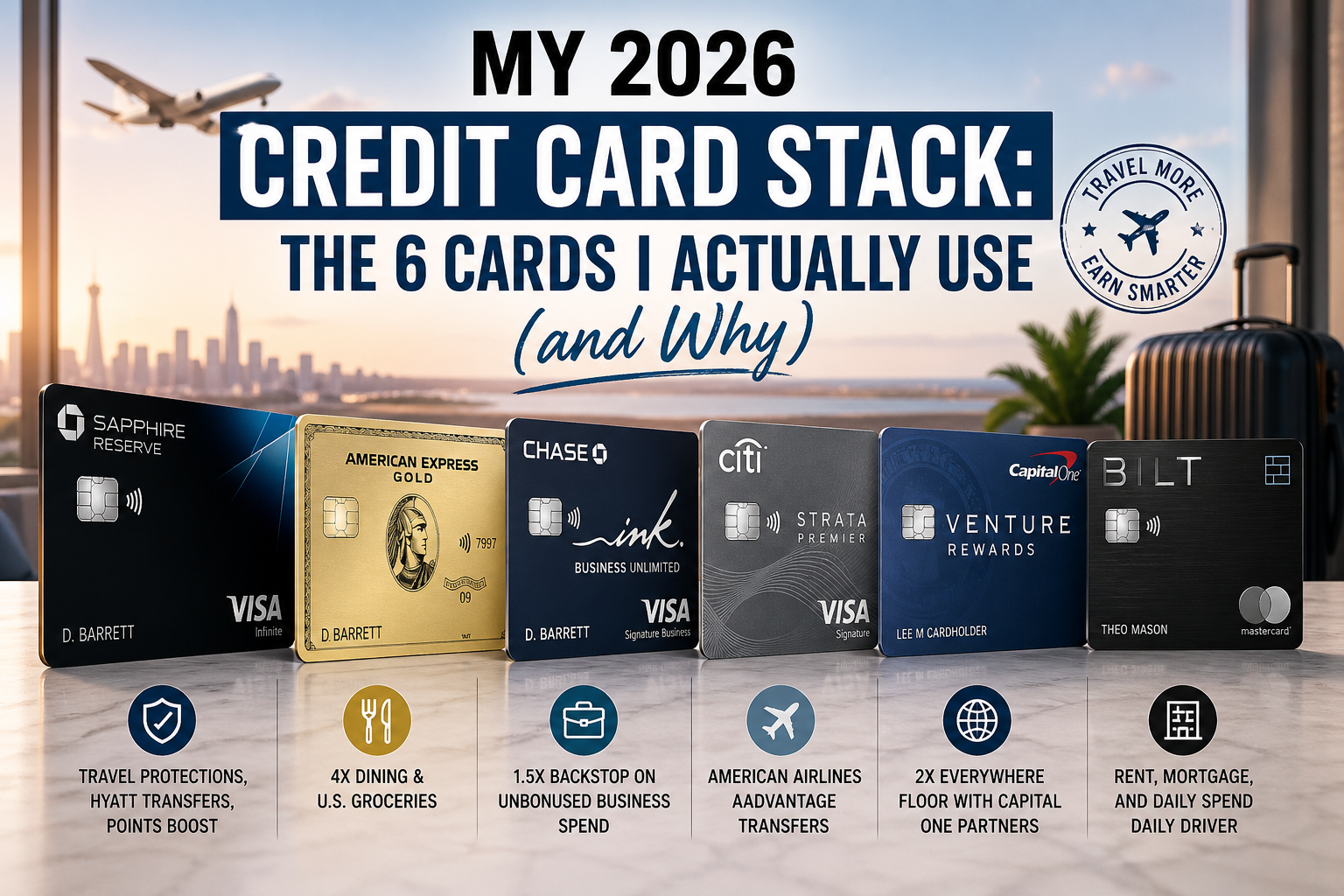
Every January I sit down, spread my cards across the desk like a hand of poker, and ask the same question: is each one still pulling its weight? After the nuclear round of refreshes that hit in late 2025 — Chase blowing up Sapphire Reserve, Citi adding American Airlines as a transfer partner, and Bilt splitting into three new cards — my wallet looked different going into 2026 than it has in years.
Here’s my exact 2026 stack, in the order I reach for them, with the honest reasoning behind each one. This is not a theoretical “best cards” list. This is what’s actually in my wallet right now, what spend I put on each, and the math I used to decide.
The Stack at a Glance
| Card | Annual Fee | Primary Role in My Wallet |
|---|---|---|
| Chase Sapphire Reserve | $795 | Travel protections, Hyatt transfers, Points Boost |
| Amex Gold (Personal) | $325 | 4x dining and U.S. groceries |
| Chase Ink Business Unlimited | $0 | 1.5x backstop on unbonused business spend |
| Citi Strata Premier | $95 | American Airlines AAdvantage transfers |
| Capital One Venture Rewards | $95 | 2x everywhere floor with Capital One transfer partners |
| Bilt Palladium | $495 | Rent, mortgage, and daily spend daily driver |
Total annual fees: $1,805. Yes, really. And yes, I track every credit I use. The math works because each of these cards earns a currency I genuinely redeem, not just hoard. Let me walk through them one by one.
1. Chase Sapphire Reserve — The One That Almost Got Cut
I’ll be blunt: the Sapphire Reserve refresh that hit in October 2025 made me seriously consider closing this card. The Chase Sapphire Reserve (CSR) annual fee jumped from $550 to $795 (a 45% increase) and the Sapphire point redemption bonuses in the Chase Ultimate Rewards portal were replaced by “Points Boost.” That’s a brutal change on top of an already expensive card.
So why is it still in my wallet in 2026? Three reasons: transfer partners (specifically Hyatt), Points Boost when it actually hits 2 cents per point, and the travel insurance that has literally reimbursed me for a cancelled flight.
What I actually use it for
I don’t put everyday spend on my CSR anymore. The 3x on travel and dining still earns, but I’d rather push those categories to Amex Gold (4x dining) and Bilt Palladium. The CSR is a redemption engine for me — I transfer Ultimate Rewards points from my Ink cards over to it, then move them to Hyatt or use Points Boost.
On Points Boost: Chase initially promised a guaranteed 2 cents per point for hotels in The Edit collection, but they’ve now transitioned to “up to” 2 cents with The Edit hotels, and that change is reflected in the terms. Not great. But 2 cent redemptions for Hyatt (via The Edit) are often better than what I might get for Hyatt points redemptions, plus they include value-add credits for the stay and still earn points and elite night credit. When a Points Boost redemption lines up, I grab it.
Making the $795 fee work
The new credit lineup is a lot to manage, but it’s usable if you already spend in these categories:
- Up to $250 hotel credit for stays at The Edit, Chase’s curated luxury hotel collection, applied to prepaid bookings of at least two nights and including daily breakfast for two, a $100 on-property credit and early check-in, late checkout and room upgrades (when available)
- $150 Sapphire Tables credit every January-June and every July-December, a $300 annual value for dining at Exclusive Tables restaurants
- $150 StubHub or viagogo credit on concert and event tickets every January-June and every July-December, a $300 annual value
- Monthly $10 Lyft ride credit through September 30, 2027, plus 5 points per dollar on all Lyft rides
- Complimentary subscriptions to Apple TV+ and Apple Music
I hit the Sapphire Tables and StubHub credits with things I’d buy anyway. The Lyft and Apple credits are gravy. If you won’t use the dining and ticket credits, the math gets ugly fast — skip to the Sapphire Preferred.
Verdict: Keep — but barely
I’m keeping the CSR because Hyatt transfers alone justify it for me, and I’m a grandfathered cardholder who still gets some legacy redemption value. If I were applying fresh today, I’d strongly consider the Sapphire Preferred instead.
2. Amex Gold (Personal) — The 4x Machine That Refuses to Die
The Amex Gold is, pound for pound, the most efficient earning card in my wallet. Cardholders earn 4 American Express Membership Rewards points per dollar spent on restaurants worldwide (up to $50,000 per calendar year) as well as on the first $25,000 spent at U.S. supermarkets annually. Plus, earn 3 points per dollar on flights booked directly with airlines and amextravel.com, 2 points per dollar on prepaid hotels booked through amextravel.com and 1 point per dollar on all other spending.
My family of four spends a lot on groceries and dining out. Running that through 4x earning has generated more than 200,000 Membership Rewards points in a single year before — which, transferred to the right partner, is round-trip business class to Europe.
The $325 fee vs. the credits
The American Express Gold Card carries a $325 annual fee charged on the card anniversary date. The offsetting credits:
- $120 annual Uber Cash ($10/month)
- $84 Dunkin’ credit ($7/month)
- $100 Resy credit ($50 semi-annually)
- $120 dining credit ($10/month at Grubhub, Cheesecake Factory, Goldbelly, Wine.com, Five Guys)
The Amex Gold benefits package delivers $424 in annual statement credits against a $325 annual fee before you earn a single point. In practice, I comfortably use the Uber, Resy, and $120 dining credits every year. The Dunkin’ one is a forced march, but I have a Dunkin’ near my office, so $7 a month happens.
Where the real value lives
Membership Rewards transfer to 19+ airline and hotel partners. My favorite moves: Air France-KLM Flying Blue for Delta premium cabins, Virgin Atlantic for ANA business class to Tokyo, and Avianca LifeMiles for short-haul partner awards. Business class from the U.S. to Europe on a partner like Air France/KLM Flying Blue starts around 45,000 to 60,000 points one-way — those same points redeemed through the Amex Travel portal would get you maybe $400-600 in flights, versus a $4,000+ business class ticket through transfers.
This is why I dismiss the “just pay cash with a 2% card” argument. When your points are worth 4+ cents each on the right redemption, a 4x card is effectively a 16%+ return.
Verdict: Permanent fixture
The Amex Gold is not going anywhere. For a detailed breakdown of my favorite transfer moves, see my transfer bonus guides.
3. Chase Ink Business Unlimited — The Free 1.5x Backstop
The Ink Business Unlimited is the quietest card in my stack, and also one of the most valuable. It’s a cash back business credit card with a straightforward rewards structure — cardmembers earn an unlimited 1.5% cash back on purchases with no need to track spending categories or activate rotating offers.
Key word: technically “cash back.” In reality, when paired with a premium card that unlocks partner transfers (either the Ink Business Preferred, Sapphire Preferred, Sapphire Reserve for Business, or Sapphire Reserve), it can effectively serve as a 1.5x everywhere backstop. Because I hold the Sapphire Reserve, my “1.5% cash back” is actually 1.5 transferable Ultimate Rewards points per dollar.
What I use it for
Anything that doesn’t have a bonus category elsewhere. Software subscriptions, business insurance, contractors, random vendor invoices. Everything that’s “non-bonused” goes here. Then I pool the points with my Sapphire Reserve and transfer to Hyatt, United, or wherever the current sweet spot lives.
The card has no annual fee, which means it’s pure upside as long as I have a premium Chase card in the family. As one commenter on Frequent Miler put it: it can be, but not without a premium Ultimate Rewards card that makes the points that it earns transferable to partners. Exactly.
The only gotcha
There is a foreign transaction fee of 3% of each transaction in U.S. dollars. So I never take this card abroad. For international spend, I use the Bilt Palladium or Capital One Venture.
Verdict: Keep forever
No annual fee. 1.5x Ultimate Rewards on everything. No brainer.
4. Citi Strata Premier — The New Star of the Show
This card is the reason I’m writing this post. For years, the Strata Premier (and its predecessor, the Citi Premier) was a “nice to have” — solid 3x on a bunch of categories, decent transfer partners, fine. Then in July 2025, everything changed.
Previously, JetBlue was Citi’s only U.S. airline transfer partner. That meant Citi cardholders hoping to redeem points for a flight on American had to go through its Oneworld alliance partners like Cathay Pacific, Qatar Airways and Qantas. Now? Citi finally added American Airlines as a transfer partner on the Citi Strata Premier, Strata Elite, and Prestige cards. They transfer at a 1:1 ratio (1 Citi ThankYou point for 1 American Airlines mile).
This is huge. In TPG’s August 2025 valuations, American AAdvantage miles are worth 1.55 cents each, versus United MileagePlus miles at 1.3 cents and Delta SkyMiles at 1.2 cents. AAdvantage has some of the best sweet spots in the game — Japan Airlines first class, Qatar Qsuites, and Finnair business class to Helsinki for reasonable mileage totals.
Why the $95-fee Strata Premier and not the Strata Elite?
The Strata Elite costs $595 and comes with four Admirals Club passes and a $300 hotel benefit. For me, the Premier wins because: I already have lounge access through the Sapphire Reserve’s Priority Pass membership, and the Premier’s 3x bonus categories on dining, supermarkets, gas, air travel, and hotels are broad enough to be genuinely useful.
My earning buckets on this card:
- Air travel booked directly with airlines (3x)
- Hotels booked directly (3x)
- Gas stations (3x)
- Supermarket spend over $25,000 (since Amex Gold caps at $25k and drops to 1x after)
The transfer strategy
I’m doing exactly what TPG’s Ben Smithson does: transferring Citi ThankYou Rewards points to AAdvantage at a 1:1 ratio and then redeeming those miles as quickly as possible, both to grab any available seats and protect myself from devaluations. AAdvantage has been known to devalue award charts with zero notice — so my rule is earn, transfer, burn.
Outside of American, the Strata Premier also gives access to Choice Privileges at a 1:2 ratio (solid sweet spots at Preferred Hotel Rewards), Air France Flying Blue, Avianca LifeMiles, Virgin Atlantic, and more.
Verdict: Instant must-have
If you don’t have a Citi ThankYou-earning card and you ever fly American or Oneworld, fix that. The Strata Premier’s $95 annual fee is the cheapest ticket into the only flexible currency that transfers to AAdvantage.
5. Capital One Venture Rewards — The 2x Everywhere Utility Card
Capital One Venture is the “I don’t want to think about it” card. It earns unlimited 2X miles on every purchase, every day, plus 5X miles on hotels, vacation rentals and rental cars booked through Capital One Travel. Miles won’t expire for the life of the account and there’s no limit to how many you can earn. Annual fee: $95.
The earning is fine. What makes this card a keeper is the transfer program, which has quietly become one of the strongest in the industry. There are 22 Capital One transfer partners: 18 airlines and four hotels. The transfer rate for most partners is 1,000 Capital One miles = 1,000 airline or hotel points.
The partners that matter
For me, the killer Capital One partners are:
- Air Canada Aeroplan — one of the most useful mileage programs in the world, with fantastic Star Alliance partner redemptions
- Turkish Airlines Miles&Smiles — 45,000 miles round-trip in United domestic business class used to be here; still great value on Star Alliance partners
- British Airways/Iberia/Aer Lingus Avios — short-haul domestic awards and transatlantic sweet spots
- Wyndham Rewards — Vacasa vacation rentals at 15,000 points per bedroom per night is absurd value
- Qantas Frequent Flyer — access to American Airlines awards from the Qantas side (though they did devalue in 2025)
New in 2025/2026: The newest transfer partners — added on Sept. 23, 2025 — include JAL Mileage Bank, Qatar Airways Privilege Club and I Prefer Hotel Rewards. Qatar is particularly interesting for Qsuites redemptions. For the full picture of what Capital One points can do, check out my redemption guides.
Why Venture and not Venture X?
Honestly? I already have two premium cards with lounge access (CSR and Bilt Palladium). The Venture X’s $395 fee isn’t justified for me when the base Venture earns the same transfer partners at the same ratios. If you don’t have a premium card with Priority Pass, the Venture X is the better pick.
Verdict: Keep for transfer access
I barely put any spend on this card. I hold it primarily for the transfer partner access and the Global Entry credit. $95 to maintain access to Aeroplan, Turkish, Avianca, and Wyndham transfers is a bargain.
6. Bilt Palladium — The New Daily Driver
The Bilt program went through a massive transformation in early 2026. The new Bilt cards — the Bilt Blue Card, Bilt Obsidian Card and Bilt Palladium Card — replace the pre-existing Bilt World Elite Mastercard Credit Card. That original card, issued by Wells Fargo, stopped accepting applications in October 2025 and was deactivated in February 2026.
I upgraded from the old Bilt World Elite to the Palladium. It costs $495 a year (the annual fee is $0 for Bilt Blue Cards, $95 for Bilt Obsidian Cards, and $495 for Bilt Palladium Cards), which is a massive jump from the $0 old card. But the earning structure changes made it worth it for my spending pattern.
The earning structure
It earns 2x Bilt Points on non-rent/mortgage spending, making it an excellent “daily driver,” especially since Bilt Points are among the most valuable, flexible reward currencies on the market. Plus rent and mortgage continue to earn, though with a slightly more complex structure than the old card.
Where it gets really interesting is the Points Accelerator. The Bilt Palladium earns 2 points per dollar spent on everyday spending as a baseline, so using the accelerator brings you up to 3 points per dollar spent on everything — a whopping 6.6% return, per TPG’s February 2026 valuations.
That 6.6% return number is bananas. Even if you discount it, 2x transferable points on everything — including Hyatt, which you can no longer access through Wells Fargo — is competitive with the Venture X and has better partners for my travel patterns.
The credits that justify the fee
The card offers perks like Priority Pass lounge access, an up to $400 annual Bilt Travel hotel credit, up to $200 in annual Bilt Cash, and more. Plus the Palladium’s airport lounge access includes two complimentary guests, which is actually better than most $395+ premium cards. And you get Gold status just by having the Palladium Card, which makes Rent Day transfer bonuses more valuable.
The catch on the hotel credit
The $400 hotel credit is split into two $200 semi-annual credits. There’s an important catch: each qualifying booking must be for at least 2 nights — this isn’t a credit you can use on a quick one-night airport hotel or an overnight stop. I plan my leisure travel around it.
Why I’m leaning into Bilt for 2026
Bilt’s transfer partner list is deep and includes some genuinely unique options (Hyatt, Alaska, plus the usual suspects). The Rent Day transfer bonuses regularly hit 100%+ on select partners, which is the kind of deal you simply don’t see elsewhere. Between housing-related earning, a true 2x on everyday spend, and transferable points to premium partners, it’s become my highest-volume card.
Verdict: New daily driver
For the first time since I got the Amex Gold, a non-Amex card is running most of my spending through it. The Palladium earned that position.
How I Route Spending Between These Six Cards
Here’s the actual decision tree I use:
| Category | Card | Rate |
|---|---|---|
| Restaurants (worldwide) | Amex Gold | 4x MR |
| U.S. Supermarkets (first $25k) | Amex Gold | 4x MR |
| Flights booked direct | Amex Gold or Citi Strata Premier | 3x MR or TYP |
| Hotels booked direct | Citi Strata Premier | 3x TYP |
| Gas | Citi Strata Premier | 3x TYP |
| Rent / Mortgage | Bilt Palladium | Variable |
| Everything else (daily) | Bilt Palladium | 2x Bilt |
| Business unbonused | Ink Business Unlimited | 1.5x UR |
| International travel (no FTF) | Bilt Palladium or Capital One Venture | 2x |
You’ll notice the Sapphire Reserve and Capital One Venture don’t show up much in the earning column. That’s intentional. I hold them for their transfer partner access and premium benefits (travel insurance, lounge access, Global Entry credit), not for everyday earning.
What’s NOT in My Wallet in 2026 (and Why)
A few notable omissions:
- Amex Platinum — For my travel pattern, the $895 fee and “coupon book” credits don’t work. I get lounge access through CSR and Bilt, and my premium travel benefits come from those two.
- Capital One Venture X — Redundant with my existing premium cards. The $395 fee doesn’t add enough over the base Venture for me.
- Chase Sapphire Preferred — Would be great if I didn’t have the Reserve, but holding both is pointless.
- Co-branded airline cards — I don’t have elite status with any single airline, so program-specific cards don’t move my needle. I’d rather keep flexible transferable points.
Frequently Asked Questions
Isn’t $1,805 in annual fees a lot?
Yes, in absolute terms. But I use every credit, and the welcome bonuses alone on any one of these cards often exceed the first year’s fees. The ongoing math works because I actually redeem points for premium cabin international travel where each point is worth 4+ cents. If I valued points at 1 cent each (pure cash back), this stack would make zero sense.
Why not just get one premium card and call it a day?
No single issuer has the best transfer partners across the board. Chase has Hyatt and United. Amex has the deepest airline partner list and best rates. Citi has American Airlines. Capital One has Turkish and Aeroplan. Bilt has Alaska (Atmos). Holding at least one card from each program ensures I can book anywhere.
Will I keep the Sapphire Reserve long-term?
I’m re-evaluating every year. Starting January 1, 2026, cardholders enjoy up to $500 in automatic statement credits annually with a maximum of $250 per transaction on The Edit hotel bookings. If I use those credits plus Sapphire Tables and StubHub, the card breaks even. If any of those credits becomes annoying to use, I’ll downgrade to the Sapphire Preferred.
Is Bilt Palladium worth it if I don’t have rent or a mortgage?
Probably not at $495. Without the housing earning, you’re paying $495 for a 2x everywhere card with decent travel credits. The Venture X at $395 or the base Venture at $95 might be a better fit. The card can be a good fit for those willing to put in the work, which may include managing two rewards currencies, determining how exactly you earn and burn them, and doing some monthly math.
Why do I need the Ink Business Unlimited if I have the Sapphire Reserve?
The Ink Business Unlimited has no annual fee and earns 1.5x on unbonused spend versus the Sapphire Reserve’s 1x on unbonused. Every dollar routed through Ink Unlimited instead of Sapphire Reserve is a 50% bonus. Over a year, that adds up to thousands of extra points.
What’s the one card you’d add if budget wasn’t a concern?
Chase Ink Business Preferred. The 3x on travel, shipping, ad spend, and select categories (up to $150k per year) at a $95 annual fee is incredible for a small business. And the welcome bonus is routinely 90,000-100,000+ Ultimate Rewards points.
Do you actually hit all the credits on the Sapphire Reserve?
No. I hit the Sapphire Tables credit, the StubHub credit, the Apple credits, the Lyft credit, and the Edit credit. I ignore some of the smaller ones if they require too much juggling. My rule: if I have to spend mental energy to capture a credit I wouldn’t otherwise use, it’s not worth including in my ROI math.
The Bottom Line
Every credit card in this stack does exactly one thing well and doesn’t apologize for anything else. The Amex Gold earns points. The Citi Strata Premier gets me to American. The Bilt Palladium wins on housing and daily spend. The Sapphire Reserve is my redemption engine for Hyatt. The Capital One Venture is my Aeroplan access pass. The Ink Unlimited catches everything else.
If you’re building your own stack, the single biggest mistake I see people make is grabbing premium cards for the prestige without doing the math on whether they’ll use the credits and transfer partners. A $95 Strata Premier plus a $0 Ink Unlimited can outperform a stack of premium cards for someone who doesn’t travel in premium cabins.
Be honest about your travel style, pick cards that match it, and ruthlessly cut anything that no longer earns its keep. That’s the whole game. Want more strategy posts? Subscribe to the ElevateMiles newsletter for weekly points and miles deep dives straight to your inbox, and check out our latest best credit cards coverage.